
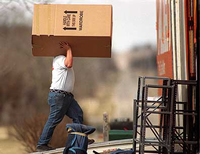
 The task of loading a truck
with all of your belongings makes for a busy day or two. If you've managed to get most of
your goods properly packed in advance, you'll have a much easier time when it comes to loading.
The task of loading a truck
with all of your belongings makes for a busy day or two. If you've managed to get most of
your goods properly packed in advance, you'll have a much easier time when it comes to loading.
Review the provider's current loading instructions and demonstrations before you start. Most rental and shipping companies publish loading guidance for their specific equipment. The more you understand about the loading process before you actually have to perform it, the better off you'll be.
First, try to establish a staging area where you can bring a large amount of your goods to be easily ready for loading. If you think of loading as putting together a big jigsaw puzzle, you'll understand why this is important. Imagine the pieces of a puzzle scattered all over your house — searching for the piece you need slows you down terribly. A handy pile of pieces lets you finish much faster. Same goes for loading the truck.
Your choice of staging area will be influenced by security concerns and the weather. Pick a spot you feel comfortable with and start filling it with items to select from to fill every nook and cranny.
Load order is unload order — in reverse
This is the one thing people don't figure out until they're already loading the truck: whatever goes in last comes out first. You don't get to choose what to unload first once you arrive — whatever's sitting at the back of the truck (the last things you loaded) is what you'll be pulling out first. So load the things you'll actually want first at your new place — cleaning tools (broom, mop, vacuum, rags, sponges), a toolkit, a coffee maker, bedding — dead last, right at the truck's back door. Load what you can live without for a few weeks first, deep at the front. Just keep that from compromising weight distribution (see below). Medications, documents, valuables, and kids' essentials travel with you, not in the truck, and chemical cleaners, aerosols, and fuel shouldn't go in the load at all.
Weight distribution comes first. Follow your equipment provider's load plan; as a general rule, heavy items go low and toward the front of the cargo area, with weight spread evenly side to side. U-Haul's trailer instructions, for example, call for about 60% of the cargo weight in the front half, with the heaviest items loaded first at the front — read them yourself and follow the instructions for your own equipment. Unload order matters, but never at the expense of a stable, properly balanced load.
Keep in mind which items are heavy and sturdy so you can stack others on top of them. The lightest items, and those that can't support much weight, should go on top for protection from crushing.
Loading boxes should be relatively simple. The odd-shaped items — bicycles, chairs, lawnmowers, grills, and others — will give you the most difficulty. See our advice on loading odd-shaped items for specifics.
Loading is also the time to take precautions against scratches and dings. The best protection is a good, thick moving blanket — scratches and abrasions happen when objects move against each other, and a blanket keeps items from direct contact. Many items may need more than one blanket, so get as many as you can.
If you can't get blankets for all of your furniture, wrapping film (plastic cling wrap) helps too. It's not as good as a blanket, but it prevents minor scratches from light contact. It's also handy for securing a blanket to an item so it doesn't slip off in transit.
The bottom line is to pack your truck solidly to avoid shifting during transit, and to keep from injuring yourself or others in the process.
Two safety rules for every load
- Never let passengers, children, or pets ride in the cargo area of a truck or trailer. Shifting cargo, lack of air, and no crash protection can kill. U-Haul's trailer instructions state this directly (read them yourself); rental trucks carry the same hazard.
- Don't carry hazardous materials, corrosives, explosives, or flammables (gasoline, propane, aerosols, and similar). Providers prohibit them; check your provider's own list.
These are general safety points, not a complete list — read your equipment provider's instructions before you load.
Before you load anything unusual, check it against the restricted items questions — eligibility, carrier acceptance, and destination rules are three separate checks, and it's much easier to sort out before loading day than after.
 Here are some thoughts for loading common items:
- Bicycles
- Chairs
- Couches and Upholstered Furniture
- Exercise Machines
- Grills
- Lawnmowers
- Motorcycles
- Pianos
- Refrigerators
- Washer and Dryer Sets
Check it yourself
Load plans and prohibited items are set by your equipment provider. Rules, prices, and instructions change and differ by service, installation, and provider — open the sources below, confirm the current details for yourself, and get your move's specifics from your transportation office in writing.
Helpful Hints
- Use the space efficiently, but not at the expense of stability. Keep heavy items low, don't stack higher than you can keep steady, and follow your equipment provider's load plan.
- A sturdy ladder or two and a supply of rated tie-down straps will help immensely. Rope and bungee cords are fine for holding loose items in place temporarily while you build the load, but they're not a substitute for rated straps at solid attachment points for securing the load itself.
- Moving thousands of pounds of belongings is very physically demanding. Pace yourself and recruit help to avoid injury and damage to your goods or the truck. See a doctor first if you have any health concerns.
- Check the weather a few days out so you know what to expect. Ramps get VERY slippery when wet.
- Don't forget gloves. Make sure they have a good grip to avoid dropping items.
In This Section
Loading Odd-Shaped Items
Advice on how to load odd-shaped items safely and securely into a truck during a PPM.
Loading Bicycles
Advice on how to load bicycles safely and effectively into a truck during a PPM.
Loading Chairs
Advice on how to load chairs safely and securely into a truck during a PPM.
Loading Couches
Advice on how to load couches safely and securely into a truck during a PPM.
Loading Exercise Machines
Advice on how to load exercise machines such as treadmills, stair climbers, weight sets, and other home gym equipment safely and securely into a truck during a PPM.
Loading Grills
Advice on how to load barbeque grills safely and securely into a truck during a PPM.
Loading Lawnmowers
Advice on how to load lawnmowers safely and securely into a truck during a PPM.
Loading Motorcycles
Advice on how to load motorcycles safely and securely into a truck during a PPM.
Loading Pianos
Advice on how to load pianos safely and securely into a truck during a PPM.
Loading Refrigerators
Advice on how to load refrigerators safely and securely into a truck during a PPM.
Loading Washer and Dryer Sets
Advice on how to load washer and dryer sets safely and securely into a truck during a PPM.